The 80/20 Rule

Recently I decided that I would look at what was working in my life and that I would do more of it. It felt like overnight my life started moving rapidly forward in a positive direction. By now most of us are familiar with the concept that what we put our attention on is magnified and grows. When we see the world in a negative light, we quickly find evidence that things are not going well. However, when we choose to focus on the positive, we just as rapidly find evidence that there is much good in the world.

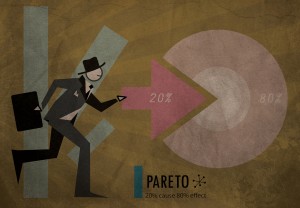
I have often thought of the Pareto principle, which is also known as the 80-20 rule, which explains that for many events, 80% of the effects come from 20% of the causes. Joseph M. Juran, a 20th century management consultant, named this principle after the Italian economist Vilfredo Pareto, who noticed that 80% of the peas in his garden came from 20% of the pea pods. Pareto further discovered that 80% of the wealth from many countries was owned by just 20% of its population. Juran applied this principle to business, suggesting that 80% of your sales come from 20% of your clients.

Many other applications of this powerful principle have since been found. Richard Koch, author of “The 80/20 Principle: The Secret to Success by Achieving More with Less”, notes that hundreds of thousands of people have found this principle to be useful, not only in their work and careers, but also in the whole of their lives.

As Wayne Dyer notes, “When you change the way you look at things, the things that you look at change.” By deliberately choosing to focus on and be grateful for all that is going well in our lives, our lives can become an upward spiral of joy and fulfillment. I hope you, too, will choose to focus on the 20% of your efforts that are accounting for 80% of your success in all aspects of your life and that your life will become all that you are hoping it can be.

Can You Multitask Your Way to Happiness?

Are you doing other things while you read these words? Are you sipping coffee? Riding an exercise machine? Listening to music? Most people find it easy to multitask when the tasks require different brain processes. We sometimes get into trouble when we try to text a friend and talk on the phone at the same time—there’s a bottleneck in the language production area of our brain—and we ind ourselves sending the wrong message to the wrong party (embarrassing, at best).

A debate is currently raging in business journals about multitasking. Some decry that by multitasking, you are doing a poorer job at each of the tasks. Others argue that executives (and moms) literally cannot do their jobs if they were to focus on single tasks sequentially. I believe that the optimal path is to discern which tasks you do easily and to mash them up readily. Save your concentrated attention for important things that require single-minded focus.

How do we concentrate in a world of Twitter, email, and text distractions? It takes great discipline, but I encourage you to set aside dedicated time to aim your laser attention on your career, book, hobby, or project until the rest of the world fades from your awareness. Runners, skiers, and race car drivers know that in moments of peak concentration time disappears—your mind works at the speed of light, making connections and integrating information from all parts of your brain.

Distinguished Professor of Psychology, Mihaly Csíkszentmihályi, describes this state of low as, “being completely involved in an activity for its own sake. The ego falls away. Time lies. Every action, movement, and thought follows inevitably from the previous one, like playing jazz. Your whole being is involved, and you’re using your skills to the utmost.”

Prof. Csíkszentmihályi believes that the “low” experience brings people an optimal level of happiness. Too little mental stimulation — we become bored and depressed. Too much — we become worrisome and anxious. Find an optimal level of engaging work that challenges you, pour passionate attention into it, and you have a recipe for a happy, fulfilling life.

Spiritweaves in Dallas


I started ballet lessons at the age of three, and by the time I was 13 I was dying to go up on pointe. For those of you who don’t know, this is the glorious transition of a ballerina from ballet slippers to pointe shoes. It didn’t matter to me about the hot, itchy lambs wool that would need to be wrapped around my toes, or that there was a possibility that my feet would become deformed and blistered, or that I would have bunions like my grandmother, or that my toes looked like they were six inches long. I would gaze longingly at the pink satin pointe shoes of the girls that would come in after my class ended, the beautiful ribbons that would decorate their ankles, the exquisite half-moon shapes they would create with the arches of their feet, and how they would twirl on the tips of their toes as if they were suspended on invisible strings. Looking down at my black plastic shoes with the elastic straps across my feet I thought, “This cannot be it.” I kept asking my teacher, “When can I go up on pointe?” She would continually hold me at bay by telling me I simply wasn’t ready yet, until finally she broke the news. “Elizabeth, you’re just too tall to be a dancer.” I believed her, and I quit.

Flash forward to August 2008. I was turning 40 and wanted nothing more than to spend it at the Esalen Institute in Big Sur, California where I journeyed twice before from Dallas within the previous eight months. Beyond the lush lawn that invited long naps in the sun, the delicious organic food, and the mineral-rich natural hot springs from the Saint Lucia mountains, Esalen had become my spiritual home, a magical retreat, the kind of place where you have to be careful what you wish for because the potency of the land is so ripe with manifestation. The Gestalt therapy of Fritz Perls, Moshe Feldenkrais’ somatic method, Gabrielle Roth’s 5Rhythms practice, and Ida Pauline Rolf’s bodywork technique, are only a few of the countless pioneer movements that were nurtured at Esalen, leaving indelible marks on the landscape of human potential. The visionary spirit that lingers in the soil of the grounds is palpable. In considering this significant celebration, it didn’t even matter what workshop I attended, but lo and behold there was a workshop with Spiritweaves, a dance practice lead by the facilitators Anneli and Michael Molin-Skelton. When I called to make the reservation, the woman who took my information asked me if I had ever danced with Anneli and Michael before. I told her no. (I was too big to be a dancer, remember?) She assured me, “They are delightful. Very special. You will love it.” I trusted Esalen, so I went.

spiritweaves
I arrived at this dance without expectation, without a deep longing or a thirst to be quenched, not seeking yet another pathway to the truth. As a yogi for 14 years, I didn’t recognize a need for another practice. I simply followed the part of me that loves to dance. I stepped into the container of the dance space and my body instantly began to move. Before my mind could protest, I found myself on the floor rolling my spine and exploring the boundaries of my edges, then up on my feet, running furiously around the room, taking on shapes that were unfamiliar, buoyant, confident, and completely free. We danced for an extended period of time in silence. No prompting, no direction, no urging from Anneli and Michael. Instead they created space, and then held it for us, and allowed us to breathe in it for a while, to explore. The music was impeccable. They weaved in and out of us in their own dance, introducing us to their humility and their vulnerability, and their genuine desire to share their love of this practice with us. Within a very short time, I realized that my identity, my ego, any part of me that clung to my sense of self-importance was absent. The Divine was being expressed in my movements. This was prayer.

anneli and michaelFrom that first experience with Anneli and Michael, I have danced with them time and time again, and each time I do, into their open arms I begin to drop in to greet myself, that familiar face at the window of my soul who often becomes a stranger to me between dances. They keep me safe while I run into the darkness of the secrets that my body has been holding, creating a space where I can be receptive to all that arises without binding me with rules, or tutus, or barre pliés. That darkness, they say, “is just one part of us, and the more we can embrace those parts of ourselves, the more we can be fully self-expressed.” Through their own study of 5Rhythms and Soul Motion practices, they invite us into a seemingly endless repertoire of exercises that evoke transformation and healing, and it would be difficult, if not impossible, to articulate the ones that have impacted me the most. So I’ll just share the one that I’ll never forget.

spiritweaves soulcardDuring one of our five-day retreats at Esalen, Anneli and Michael led us through a wave of music that was long and deep. I came to the end of it feeling especially open, and my mind intensely quiet. They invited us to make what they called “soul cards”. Around the room they had placed groupings of magazines, picture books, glue, scissors, X-acto knives, and stacks of five by eight-inch boards made from heavy cardstock. Their guidance was to begin by flipping through the magazines and books, and tear out anything that spoke to us – words, images, colors. They asked us not to intellectualize the experience, or try to analyze why we were attracted to certain things. Instead they gave us permission to let our creativity be expressed in the cards.

That evening we gathered in a circle after Anneli and Michael led us through another wave of music. They asked us to bring one of our soul cards to the circle with us, and explained the nature of the exercise. When we were called (which, by the way, is always a caveat that Anneli and Michael lay down at the beginning of every exercise), we were invited (another caveat) to enter the circle with our soul card, and take a shape that expressed the essence of how the card spoke to us. At that point, we were to be joined in the circle by at least two other dancers who would take on the same shape. From there we were asked to speak the words, “I am the one who…” and then finish the sentence with a word that organically completed it. The direction was to do so, again, without intellectualizing, as raw of an expression as possible.

spiritweaves-workshopsI was eventually inspired to move to the center of the circle with my soul card. The shape that my body took on was similar to a child’s pose in yoga, hips at the heels, forehead on the floor, shoulders rounded forward, arms draped at my sides, hands near my feet, and palms facing upwards. Michael called several dancers to come out on the floor and take the same shape. Slowly my body began to uncurl, and I started to stand up on my knees with my arms hanging by my side. Out of my mouth came, “I am the one who was left behind.” I stood up a little taller on my knees and my arms raised up over my head, and I screamed, “I am the one who knows that if I’m not perfect, you’ll leave me!” With that, Michael cued the other dancers around me to begin to chant, “I AM NOT PERFECT. I AM NOT PERFECT. I AM NOT PERFECT.” And from there, he said, “Liz, I want you to dance imperfection.” My heart was pounding out of my chest in gripping fear, yet in that instant, I was crisply aware that it was the time to face this demon, to dispel the story that the only way to be worthy was to be perfect. So I let go, in a way that I hadn’t let go before. I stumbled. I was off beat. I didn’t care what it looked like. I let myself be seen by the other dancers and most importantly, by my teachers, the ones who I was certain would disapprove. I allowed the fear of being left behind to move my body and my breath. I loved myself inside this feeling of imperfection. At the end of the dance, I stood at the back of the circle and looked at the other dancers. They stopped chanting. Michael said, “Take a look around. You are not perfect, and they are still here.” I stood there as long as I needed to stand there, and I wept. Too tall to be a dancer? I think not.

To say that their gifts are immeasurable, that their partnership in life is inspiring, that their ability to hold space is impeccable, that their compassion, generosity, and love is boundless, would diminish the gratitude I hold in my heart for their presence in my life. Instead I will merely invite you to dance with Anneli and Michael. In the words of David Whyte, “Sometimes with the bones of the black sticks left when the fire has gone out, someone has written something new in the ashes of your life. You are not leaving. You are arriving.”

Anneli and Michael will be in Dallas August 6th through 8th at the Sammons Center for the Arts. To register, contact Monica Blossom Hochberg at 214/597-6800 and/or visit www.flowetryinmotion.com. For more information about Spiritweaves, visit www.spiritweaves.com.

spiritweaves

Welcome to Holistic Networker

Holistic NetworkerYour guide to wellness. Holistic Networker is published four times a year on the first of January, April, July, and October. We distribute 28,000 copies throughout North Texas, another 28,000 visitors download the digital copy. Our website is visited by over 8,000 people each month.
• find local holistic practitioners
• learn about alternative treatments
• check out local events listings
• find wellness courses and seminars
• enjoy the seasonal astrology report
• read book reviews

Download the current issue today or pick up a free copy at one of our 250 distribution sites.

Your Spring Stars (2010)

Cynthia NovakWelcome spring with exciting new growth and purposeful action. Winter is over or on its final glacial gusts. We are on time to break out of heavy layers, and shake ourselves free. Nature bursts out of dormant branches into buds. She has to push out of buds into blooms. Finally she calls the bees and butterflies to pollinate and set fruit. It all happens in a few months. There is nothing quite as tenacious and determined as a chick pecking its way out of the egg: Or as patient as a butterfly emerging from its chrysalis. Slow down and watch. Prepare to do what is needed to transform your own life. We are one of Earth’s creatures and like the rest, we are compelled in one way or another to break free and embrace the gift of birth. Perhaps the powerful Mars transits are the push you need to start pecking free. Perhaps you are waiting for the kiss of sunshine to emerge and stretch your wings. There is no guarantee except that the process is part of us. It will be a mix of pain, joy, struggle and ease. It is filled with opportunity. Some will fall into change, while many more are compelled to move out of the womb into action. Just like the beginning of all life, it is natural. No matter how you emerge; You are right on time.

Mars, the planet of action and energy, is moving forward. There is no better use of Mars’ momentum than purposeful action. In many ways, nature’s creatures only know purposeful action. They have work to do and emerge with the assignment to live, play, procreate, protect, and enjoy food. Often they have loads of fun in the midst of very busy lives. They do not feel sorry for themselves.

Two years ago my dear husband suffered a crippling stroke. Since that time it’s been a daily–even hourly–commitment by both of us to regain his speech, cognition, mobility and use of his right arm. One day I asked him why he didn’t feel sorry for himself. He said that he has much to do to recover, and that if he did that, he wouldn’t be able to do what it takes to heal. This was such a gift to me. I was feeling sorry for myself and it literally sapped my energy and joy. Mars is now moving forward.

April: Mars is moving and we are emerging. Mars is all about activity. “Let’s do it my way now!” “Are you with me or against me?” The desire for purposeful action is strong. Watch as properties move on the market and economic news tentatively gets stronger. Think of Mars as the Market. When Mars gains momentum after a lull, folks stop worrying about risk as much as they worry about missing an opportunity. Take care of the details. Get your taxes or extension done. Mars is moving forward and while Mercury goes retrograde this month, it doesn’t confuse communication until the 17th. Retrograde Mercury is good for mental rest and miscommunication until May 11th. April is more than taxes and duty; she brings a lovely transit of Venus, the planet of love and money. In Vedic astrology Venus is happy in Taurus from April 20th until May 15th. There is action, play and romantic potential everywhere. Get on out of that chrysalis and spread your gossamer wings! It’s what’s natural.

May: May begins with Venus at her best. That means spending more to get the very best she can almost afford. This should be good for retail. If you are on a budget, then you had better be creative or shop resale. Think of it as recycled style. If you’re holding onto that cocoon, then it’s time to push on out. You could change your image with a makeover. Saturn, as structure, faces Uranus, the planet of change. They started their dance last year. Now they are facing each other again. Their push isn’t just seen in society…it is also evident in appearance and abundance and maybe even a big change in work or residence. Would you like to change your abundance? Jupiter joins Uranus: Jupiter’s lessons are about excess. What do you do with your cash? What brings you freedom and what holds you down? What did you learn from the last boom and bust? Think of Jupiter as your personal guru and Uranus as ways to set yourself free. Jupiter is in a constellation he enjoys: Pisces. However, he will teach us in some manner through excess. It could be through excessive fear or doubts. It might be through excessive caution, eating or spending. Venus is in the lunar mansion Rohini which means “the most beloved wife.” Venus here likes nice things. It doesn’t mean lots of them. It just means the ones you really like. President Obama has his Moon there. He likes to look good in his well-tailored suits. He didn’t get them until he made the money. We can learn from him there. Indulge where we can, appreciate and nurture what we’ve planted, and learn what fits us well.

June: Jupiter and Uranus spend the month together. We continue to learn: What liberates you and when do you feel trapped? I expect plenty of weddings. Commitment can liberate you when you’ve worked to develop a relationship. I expect plenty of mergers in the corporate world, too. The Uranus knot to untie is how to balance commitment and freedom: Is the notion that sharing life or debt or a name will cost you your individuality true for you? Or is that union what might just free you to evolve and grow through love and the desire to be protected or the strength to be the protector? Yes, there will be plenty of second thoughts. Some “mergers” might be delayed until the beginning of 2011. But overall, Saturn is the wisdom of age and time. He shows you the joy of simple daily experience and the truth that we will all age and ultimately die. Saturn facing the Jupiter-Uranus union reminds us that there is strength in commitment and there is value in being there for another. This might be a friend, a colleague, an acquaintance, family member or even a stranger. It is valuable to be there for another person and that investment will cost you some of your own freedom. Jupiter reminds us that it is a joyful investment, Uranus reminds us that it is ultimate liberation to give and Saturn shows us how we are more like the old folks than we could have ever imagined. It’s a good time to enjoy each hour of each day…Even if they look like a burden.

How the Love Grows: It grows cautiously. Planets in opposition are like a great scale weighing and assessing. Fortunately, Venus and Mars are both moving ahead. Venus is ready to love again and Mars is finally ready to lead her on the dance floor of romance. The only question for you: Who wears the Mars in your relationship?

Where the Money Flows: It too moves. Wise investors look at many different areas. The Mars momentum is actually good for risk. A busy Mars is often an indicator that more investors are in. Real estate and energy are gaining strength. I’m not a financial person, but I do know that when the economy makes an adjustment more people and businesses move to Texas. In general, money and risk are on again. Those powerful opposition planets indicate caution and ups, downs then ups again. Growth is everywhere, it’s just doing a shuffle rather than running a sprint.

Something old is New Again: The big transit this season is Saturn, the planet of structure and form, opposing Uranus, the planet of change. We all talk about change, but like a chick that suddenly outgrows his egg; we wait until the familiar no longer fits. In terms of the outer planets, the change is a long process. Uranus often brings a situation that looks crazy or people who seem to act out in odd ways. The balance with Saturn structure and Uranus change is to build something more useful rather than simply destroy something old. The “Tea party” movement is a great example of the Saturn-Uranus dance. In May, Jupiter, the politician of the heavens, joins Uranus. Watch faces in the news and in this movement. Sara Palin is its darling now. She’ll have plenty of competition for that spot this summer. Jupiter takes the Uranus-Saturn dilemma and turns it into a political platform. The hope of change is met with fear in all of life. But Jupiter steps onto the platform and says the hope of political power comes from the power to persuade and because “We the People” are what “they the candidates” need.

The Obama Presidency: Mars or action was stymied earlier this year. On March 11th, Mars finally started to move forward. In Vedic astrology, there are planets that can bring great success and those that could bring us down. Mars’ nature is to be of service: to push forward in the face of opposition and to take risks. In the President’s chart, Mars is in a very stressful position: At the very last degree of a constellation. As a candidate for the Democratic nomination, President Obama moved slowly and carefully. He allowed his opponents to charge ahead. He was the wise one with insight, tolerance and patience. His message was simple and spoke to the desire of many for vision and change within the structure. These traits are Saturn’s virtues with Jupiter’s enthusiasm. He has a beautiful Saturn in his chart. Saturn is uplifted by Jupiter’s optimism and they are both at the very front of his chart. They represent birth and faith in the process.

As I write this, I don’t know what happened with the Healthcare vote. I know that the President at least appears to be pushing ahead. I know that he must be impatient and frustrated. I would like to remind him of his Saturn gifts and of the potential for folly if he charges into battle without enough troops or experience. I know that this legislation will only succeed if he finds a way to bring the opposition to the table: Some way to convert them to the purpose and value of change without destroying the system that exists. Mars isn’t his friend. I suspect that there is much personal frustration behind the scenes. As the captain of this country, this legislation could be his albatross, and could ultimately pull his presidency down. I expect him to simplify the legislation and start with a foundation for success: To work with the planets and not against them. If not, it could turn his legacy into a sinking ship. Mars charges ahead and he will be tempted to push it through if possible. But that will not warrant success. It could be just the distraction the opposition needs. What I want personally isn’t the issue here. It’s which planets bring him success. I ask for wisdom and cooperation to restructure rather than destroy.

President Obama has the lovely Venus on his Moon in May. That should bring cooperation, charisma and charm through him. Throughout the year, the First Lady continues to enjoy lovely Jupiter transits without the Mars distractions. Her popularity will continue to grow and she will have measurable success with her campaign to stop childhood obesity. She is a rising star. Her husband is obviously successful, but he is at the end of a major cycle in his life. For any person it is filled with crossroads: It could lead to a one term Presidency or failure. I do expect some sort of bill to pass. Will it thrive and be a success or will it be mired in bureaucracy? That is the question.

Cynthia Novak is a professional astrologer. She can be contacted at metro 817-261-2984. Read Cynthia’s daily astrological message at www.HolisticNetworker.com/dailymessage/ or see www.CynthiaNovak.com Come hear Cynthia’s talk at the Wellness Expo in Fort Worth on Sunday, April 18 at 11:30am entitled “Astrology & You”.

Massaging Preterm Infants Enhances Growth

After over two decades of research, experts have concluded that massaging stable preterm infants leads to greater weight gains and earlier discharge. There appears to be a biological cause and effect between stroking, massaging, and grooming infants and their growth. Studies show that massage stimulates growth-promoting hormones. Massage therapy also increases the enzymes that make the cells of an infant’s vital organs more responsive to the growth-promoting effects of these hormones.

Conversely, researchers have discovered that infants deprived of massage therapy showed lower levels of growth hormone. Even when infants were given injections of growth hormone, they failed to grow at a rate comparable to massaged infants. This suggests that massage impacts infants at the cellular level.

Other studies specifically show that massage therapy has consistently led to increased weight gains in preterm infants. While massaged infants do not consume or retain more formula, weight gains are believed to be due to better conversion of food into growth. Some believe this to be due to a reduced adverse reaction to stress. It has also been suggested that an infant’s energy expenditure drops considerably after several days of massage therapy. This drop in expended energy may be partly responsible for the enhanced growth caused by massage therapy.

In a study conducted by Dr. Frank Scafidi that won the NIMH Research Science Award #MH00331, 40 medically stable preterm infants were assigned to treatment and control groups. The treated infants received tactile/kinesthetic stimulation for three 15-minute periods during three consecutive hours per day for a 10-day period. Sleep/wake behavior was monitored and the infants were evaluated at the beginning and at the end of the treatment period. The treated infants averaged a 21% greater weight gain per day.

Be sure to consult a trained medical professional before beginning massage therapy on preterm infants.

For more information on massage therapy, please contact Pacific College of Oriental Medicine at (800) 729-0941, or visit www.PacificCollege.edu

Acupuncture for Arthritis

Ancient AcupunctureMillions of Americans report that they cannot perform simple everyday tasks such as tying a tie or opening a jar, because of the debilitating pain of arthritis. Twenty percent of all Americans say that their arthritis symptoms are so severe that it has affected their job performance and their general ability to enjoy life. Despite what one may think, arthritis is not just an “old persons” disease. In fact, almost two-thirds of those with some form of arthritis are younger than age 65. There are two main forms of arthritis: rheumatoid arthritis and osteoarthritis. In recent studies, acupuncture has been shown to be effective in reducing the symptoms of both.

A study conducted in Germany looked at over 300,000 people with osteoarthritis of the knee. Participants in the study received 15 sessions of acupuncture combined with their usual medical care. During the study, those that had the treatments reported less pain and stiffness, improved function, and better quality of life, than those who had received routine medical care alone. Interestingly enough, those that had the acupuncture treatments, also reported less severity of their symptoms for three months after the study, when they were not receiving acupuncture at all.

Another study was conducted in China on victims of rheumatoid arthritis. Here, participants were treated with traditional acupuncture as well as another technique called electroacupuncture, which uses minute bursts of electricity to stimulate the acupressure points. Participants receiving both the traditional and the electroacupuncture reported significant decreases in the severity of their symptoms.

As when it is used to treat any condition, according to TCM, acupuncture relieves the symptoms associated with arthritis by improving blood and qi flow to the affected areas.

Acupuncture decreases the pain associated with arthritis by increasing the release of neurotransmitters that block pain. The meridians or acu-points that are located along nerve pathways are stimulated by the needles and then send signals to the brain to release endorphins. Endorphins are chemicals that are very similar in nature to morphine that are released in the body during times of pain or stress. The painless acupressure needles “fool” the nerves into thinking they are in pain, and the brain releases the chemicals in response.

Today, acupuncture is so widely accepted as a treatment for arthritis that it is even covered by some health insurance companies. So if one is suffering from any form of arthritis, always consult a doctor first, and if acupuncture is recommended, be sure to check and see if the treatment is covered by insurance.

For more information on acupuncture, please contact Pacific College of Oriental Medicine at (800) 729-0941, or visit www.PacificCollege.edu

Book Review: One Soul, One Love, One Heart

One Soul One LoveIf we’re not getting along with the people in our lives, what good is all our spiritual ‘progress’? Demonstrating the interconnection between our spirituality and our relationships, John E. Welshons begins his One Soul, One Love, One Heart: The Sacred Path to Healing All Relationships with a parable: a yogi meditates in his mountaintop hermitage for many years, eventually reaching the pinnacle of enlightenment, radiating an aura of peace and wisdom. That is, until he goes down to the nearby village and is accidentally shoved by a peasant, at which point he loses his hard-won serenity and explodes at the poor fellow. Therefore, no matter what spiritual path we follow, our first priority is maintaining good relationships, whether romantic, familial, professional, or casual.

Synthesizing many spiritual traditions, including elements of Buddhist, yogic, and western psychology, as well as his own experience as a counselor and workshop leader, Welshons constructs a broad three-point plan for relationship repair, ‘Seeing the Light,’ ‘Freeing the Light,’ and ‘Being the Light,’ that easily resonates no matter our background or beliefs. Endeavoring to cover the entire spectrum of human relationships, from the difficulties of caring for an aging parent to the lessons we can learn from our pets, Welshons’ advice remains sound, even when resorting to speaking in generalities. Writing in a gentle, even playful tone, he never allows the enormity of the task—the reform of all our interpersonal relationships–to feel overwhelming. For as Welshons points out, the path to healing our relationships is not to dwell on the problems that beset us, but to see the opportunities for greater love that surround us.

One Soul, One Love, One Heart: The Sacred Path to Healing All Relationships

Book Review: The Five Ways We Grieve

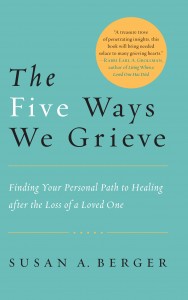
The Five Ways We GrieveCurrent pop psychology in America tells us that grief proceeds in five specific stages: denial, anger, bargaining, depression, and finally acceptance. But how do we make sense of things when our grief does not follow the rules? How does this help us move forward in life after a loss that radically changes our view of the world?

Following the loss of her parents and friends, Susan Berger, found that her own grieving process failed to follow this rote progression and that she needed additional tools to move beyond her loss. Through research and ten years of working with the bereaved Berger, a counselor and hospice volunteer, found that while people move through their grief in unique ways, they appear to follow five main archetypes: the Nomad, who wanders with unresolved grief and fails to establish a new identity; the Memorialist, who focuses on honoring the deceased; the Normalizer, who works to recreate the life they lost; the Activist, who helps others dealing with similar issues; and the Seeker, who explores philosophy in an attempt to reestablish meaning in life.

Within each type Berger gives numerous and varied profiles to illustrate the coping pattern along with its advantages and disadvantages, strategies for healing and growth, and questions for further exploration. Thus, finding ourselves in these archetypes assists not only in giving meaning to loss, but also allows us to grow and create a new healthy direction and worldview.

Often heartbreakingly direct, but always gentle and respectful, The Five Ways We Grieve speaks frankly and refreshingly about the diverse impacts of death and loss. Endeavoring to connect each person to assistance appropriate for their grieving, Berger concludes the book with an appendix of resources for self-help, while acknowledging that any advice from others can only play a part in our healing. Ultimately it is we who must journey through our grief, to find hope and re-embrace the fullness of life.

The Five Ways We Grieve: Finding Your Personal Path to Healing after the Loss of a Loved One

Book Review: Beyond Tolerance

Beyond ToleranceThough warriors of peace are certainly not hiding in the shadows, it often seems as though they are because of the media attention to those who preach and practice intolerance. To help shine a light on this important and inspirational work, Gustav Niebuhr in Beyond Tolerance profiles the efforts of organizations and individuals rooted in different faiths, but working together to build their communities and help those in need. Through their cooperative labor they not only create a better life for themselves and those of their faith, but along the way they discover the essential ties of love and compassion connecting every faith. Niebuhr echoes Martin Luther King, Jr. in calling this a “Hindu-Moslem-Christian-Jewish-Buddhist belief.” Niebuhr eagerly notes that many interfaith groups came together in response to 9/11, dispelling the mis-belief of the time that ecumenicism was impossible.

Writing in spare, direct prose, Niebuhr argues that in this time of continued strained interfaith relations, an ecumenical spirit is not only possible, but essential: “We can hardly discount the possibility,” he writes, “that a single individual emerging from an encounter with someone of a different faith convinced that they share a common humanity might make a difference. Occasionally, one person can stop a mob.” Whether the individuals profiled in Beyond Tolerance will indeed stem the rising tide of intolerance remains to be seen, but their efforts and Niebuhr’s sentiments deserve a fervent “amen.”

Beyond Tolerance: Searching for Interfaith Understanding in America (The Documents of 20th-century art)